
Chapter 1
How solar works
Panels turn sunlight into electricity, an inverter makes it the kind your home uses, and anything you do not use right away goes to a battery or back to the grid.
A solar panel is made of photovoltaic (PV) cells, thin slices of silicon that release electrons when sunlight hits them. That flow of electrons is electricity, but it is direct current (DC). Your home, and the utility grid, run on alternating current (AC), so every system has an inverter that converts one to the other.
From the inverter, power goes to your electrical panel (the breaker box) and out to whatever is switched on. Your home always uses solar first. If the panels make more than you need, the extra flows out through your utility meter to the grid, or into a battery if you have one. At night, or on a heavy monsoon afternoon, the grid or battery fills the gap. You never have to flip anything; it all happens automatically.
Interactive guide
How grid-tied solar works
Follow the electricity from your roof to your appliances, and see how your home trades power with the utility grid through the day.
The panels make what the house is using, so nothing crosses the meter.
The house is covered and the extra power runs out through the meter to the grid.
The panels have stopped for the night, so the house runs on power from the grid.
- Solar
- 3 kW5 kW0 kW
- House
- 3 kW3 kW2 kW
- Grid
- 0 kW2 kW out2 kW in
The six parts, in the order power flows
1Solar panels
Photovoltaic (PV) cells turn sunlight into direct current (DC) electricity. Panels usually go on the roof, but they can also go on a ground mount, a garage or a patio cover.
In Arizona: south- and west-facing roofs produce the most. West-facing panels keep producing into the late afternoon, when power costs the most on many utility plans.
2Inverter
The inverter turns the panels’ DC electricity into alternating current (AC), the kind your outlets and the utility grid use, and keeps it in step with the grid. Some systems use one inverter on the wall; others use a small microinverter under each panel.
In Arizona: heat shortens an inverter’s life, so we mount them out of the afternoon sun where we can. A red light or error code? See what an inverter error means.
3Electrical panel
The electrical panel, or breaker box, sends AC power to the circuits in your home. Solar power and grid power both feed it, and your appliances cannot tell the difference.
Worth knowing: older or smaller panels sometimes need an upgrade before solar can connect. We check yours on the free site visit, so it is never a surprise later.
4Your appliances
Your “electrical load” is everything drawing power right now: lights, the fridge, the TV, the pool pump. The house always uses solar power first, and the grid quietly makes up any shortfall.
In Arizona: air conditioning is most of the load in summer, so we size systems from your summer bills, not your spring ones.
5Utility meter
A two-way (bidirectional) meter counts the power you take from the grid and the power you send back to it, separately, so the utility can bill and credit you correctly.
In Arizona: APS, SRP or TEP sets up this meter after the city inspection. That is the last step before you are allowed to switch the system on.
6Utility grid
The grid powers the house whenever the panels fall short, including every night. When the panels make more than the house needs, the extra flows back out through the meter.
In Arizona: what you are credited for that extra power depends on your utility and rate plan. See our guides for APS, SRP and TEP.
Read more: How photovoltaic cells work What an inverter does Grid-tied systems
Next chapterThe equipment→Chapter 2
The equipment
Every system has panels, racking, an inverter and monitoring. A battery is optional. The inverter type is the choice that matters most.
Solar panels
Most homes now get black monocrystalline panels of roughly 400 watts each. Higher-efficiency panels make more power from the same roof space, which matters on smaller or oddly shaped roofs.
Racking and mounting
Aluminum rails bolted to the roof structure, flashed and sealed so they do not leak. Tile roofs need tile hooks or replacement tiles; ground mounts sit on concrete footings.
Inverters
Turn DC into AC. See the comparison below. In Arizona heat, where the inverter is mounted (shade, airflow) affects how long it lasts.
Monitoring
An app or web page showing what the system makes, panel by panel with microinverters. It is how you, and we, spot a problem early.
Battery (optional)
Stores solar for the evening or for outages. Sized in kilowatt-hours. Covered in chapter 8.
Disconnects and meter
Safety switches that let firefighters and utility crews shut the system off, plus a meter that measures power in both directions.
String inverter, microinverters or hybrid?
| String inverter | Microinverters | Hybrid inverter | |
|---|---|---|---|
| What it is | One box on the wall for the whole array | A small inverter under every panel | One box that handles solar and a battery |
| If one panel is shaded | Can drag down the whole string | Only that panel is affected | Like a string inverter, unless paired with optimizers |
| Monitoring | Whole system | Panel by panel | Whole system plus battery |
| Typical warranty | About 10 to 12 years | Often 25 years | About 10 years |
| Good fit for | Simple, unshaded roofs on a budget | Shade, several roof faces, future expansion | Homes adding a battery now or soon |
Read more: Enphase systems What panels are made of Solar definitions
Next chapterGrid-tied, battery or off-grid→Chapter 3
Grid-tied, battery or off-grid
Most Arizona homes go grid-tied. Add a battery if outages or evening rates bother you. Off-grid is for properties the power lines do not reach.
| Grid-tied | Grid-tied with battery | Off-grid | |
|---|---|---|---|
| Connected to the utility | Yes | Yes | No |
| Power in an outage | No, it shuts off for line-worker safety | Yes, for the circuits the battery backs up | Yes, it is your only supply |
| Upfront cost | Lowest | Higher | Highest, needs a large battery bank |
| Best for | Lowering the bill | Lower bills plus backup and evening use | Cabins, ranches, wells, remote land |
A standard grid-tied system turns itself off when the grid goes down, even on a sunny day. That surprises a lot of people. If you want power in an outage you need a battery, or a system designed to run without one (see chapter 8).
Read more: Grid-tied vs off-grid Off-grid solar Solar in a power outage
Next chapterIs my home a good fit?→Chapter 4
Is my home a good fit?
A roof facing south or west with little shade, and enough years left in it, is ideal. No good roof? A ground mount or carport often works.
Interactive check · about 1 minute
Is solar a good fit for your home?
Answer six quick questions. You get a rough fit score, a system size to expect and the chapters worth reading first.
- Direction. South-facing roofs collect the most energy over a year. West-facing roofs make a little less in total but more in the late afternoon, which can line up well with Arizona's peak-price hours. East works too. North is usually a last resort.
- Shade. Trees, chimneys and neighboring houses all count. A little shade is manageable with microinverters; heavy shade much of the day usually is not.
- Roof age and type. Panels last 25 years or more, so if the roof needs replacing in the next few years, it is cheaper to do it first. Tile, shingle, metal and flat roofs can all take solar; each mounts differently.
- Space. A typical 400-watt panel takes about 21 square feet. Fire codes also require clear walkways at the roof edges and ridge.
- Your HOA. Arizona law (A.R.S. §33-1816) does not let homeowners associations ban solar panels. They can set reasonable rules about how panels look or where they go, as long as the rules do not stop the system working properly.
- Electrical panel. Older or smaller main panels sometimes need an upgrade to take solar. We check this on the site visit.
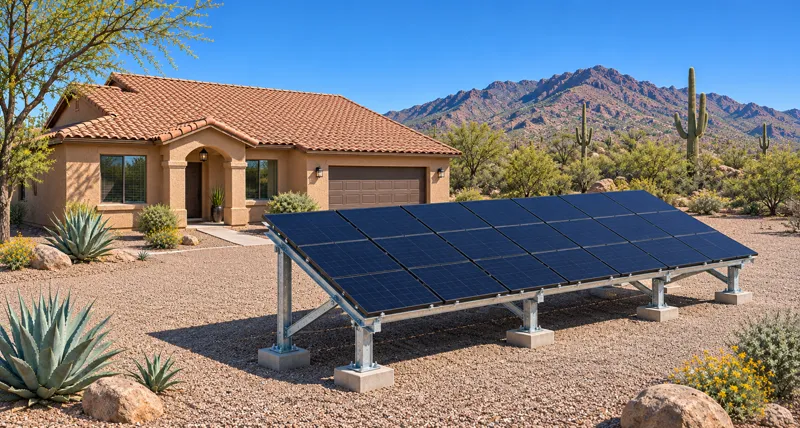
Read more: Is my roof good for solar? Is ground-mounted solar right for you? Solar and roof replacement
Next chapterSolar in Arizona→Chapter 5
Solar in Arizona
Arizona has some of the best sunshine in the country. Heat and dust trim output a little, and your utility's rules for exported power shape how a system should be sized.
Sun
Arizona gets more strong sunshine than almost anywhere in the US. A well-placed system here produces roughly 1,600 to 1,800 kWh a year for every kilowatt of panels, far more than the same system would in most states.
Heat
Panels are tested at 77°F. They lose roughly 0.3 to 0.5% of their output for every degree Celsius hotter they get, so on a 115°F July afternoon they make a bit less than their label. Good airflow under the panels helps, and the long sunny days more than make up for it.
Dust and monsoons
Dust settles between rains and cuts output. Monsoon storms rinse panels off, but often leave a film. A cleaning once or twice a year is worth it for most homes.
How your utility credits solar
Power you use yourself is worth the full retail price, because you did not have to buy it. Power you send back to the grid is credited differently depending on your utility:
- APS and TEP use net billing. Exported power is credited at an export rate approved by the Arizona Corporation Commission, which is lower than what you pay for power. The rate in effect when you connect is generally locked in for 10 years.
- SRP sets its own rules as a public power utility. Solar customers move to specific price plans, and some of those include demand charges based on your highest usage in a short window.
- Co-ops such as Trico and ED3 each have their own solar policies.
Because exported power is worth less than power you use, systems here are usually sized to cover what you use, not to export as much as possible. A battery can help by storing the afternoon surplus for the evening peak. Rates and rules change, so we check your utility's current plan before we design anything.
Read more: Net metering vs net billing The SRP solar rate plan Does Arizona have net metering?
Next chapterSizing a system→Chapter 6
Sizing a system
Start from your yearly electricity use, in kilowatt-hours, from your utility bills. Divide by how much a kilowatt of panels makes here, and you have a rough size.
Look for "kWh used" on your bill. Summer months run high in Arizona, so an average of all twelve gives the best answer.
- System size
- 8.5 kW
- Panels (400 W)
- 22
- Roof space
- 460 sq ft
- Yearly production
- 14,400 kWh
A rough guide, assuming about 1,700 kWh a year per kilowatt and no shade. Your real design depends on your roof, direction and utility plan. Get an exact number.
Plan ahead when you size. An electric car adds roughly 250 to 400 kWh a month for typical driving; a pool pump, a new air conditioner or a home office can add more. It is usually cheaper to size for those now than to add panels later.
Read more: How many panels does my house need? Solar and electric cars
Next chapterCosts and paying for it→Chapter 7
Costs and paying for it
Price depends mostly on system size, roof type and equipment. Owning, with cash or a loan, usually saves the most over time. The 30% federal credit ended for installations completed after 2025.
What moves the price: the number of panels, the inverter type, the roof (tile takes more labor than shingle), whether the electrical panel needs an upgrade, and whether you add a battery. Payback, the years it takes for savings to cover the cost, depends on that price, how much power you use yourself, and your utility's rates.
| Cash | Solar loan | Lease or PPA | |
|---|---|---|---|
| Who owns the system | You | You | The leasing company |
| Upfront cost | Full price | Little or none | Little or none |
| Long-term savings | Highest | High, minus interest | Lowest |
| Selling your home | Adds value, transfers with the house | Pay off or transfer the loan | Buyer must take over the contract |
The 30% Residential Clean Energy Credit covered installations completed from 2022 through December 31, 2025. Systems installed after that do not qualify. If you installed before then, you may still be able to claim it or carry it forward. See the details and the calculator.
Read more: What solar costs in Arizona How long payback takes Our financing partners Solar loans explained
Next chapterBatteries and backup→Chapter 8
Batteries and backup
A battery stores solar for the evening and keeps chosen circuits running in an outage. How long it lasts depends on its size and what you run.
Batteries are measured two ways: capacity in kilowatt-hours (how much energy they hold) and power in kilowatts (how much they can deliver at once). A battery with 10 kWh of usable capacity running 1 kW of fridge, lights, internet and fans lasts about 10 hours, longer if the sun comes up and recharges it.
Most homes back up the essentials rather than the whole house. Central air conditioning draws a lot of power, so backing it up needs a much bigger battery, or several. In Arizona, a battery can also earn its keep daily by covering the expensive evening hours with solar stored in the afternoon.
Battery backup planner
How long would a battery keep you going?
Tick what you would want running during an outage. We will show roughly how long each battery size lasts, with no sun to recharge it.
Rough guide. Real run time depends on the battery's usable capacity, how hot it is, reserve settings and whether the sun is recharging it. Big motors (AC, well pumps) also need a battery that can deliver enough power at start-up.
Battery or generator?
A generator runs as long as it has fuel and handles big loads, but it is noisy, needs maintenance and does nothing for your bill. A battery is silent, automatic and works every day. Some homes have both.
Adding one later
You can add a battery to an existing solar system, including one someone else installed. We check your inverter and electrical panel to see which batteries will pair with it.
Read more: Adding battery backup Battery vs generator Avoiding peak-time charges
Next chapterGetting it installed→Chapter 9
Getting it installed
The work on your roof usually takes one to three days. Design, permits and utility approval take longer, often a month or two in total.
- Consultation and quoteWe look at your bills, your roof on satellite and your goals, then give you a written quote.
- Site visit and designWe measure the roof, check the structure and electrical panel, and finalise the layout.
- Permits and utility applicationWe file with your city or county and your utility. This step sets most of the timeline.
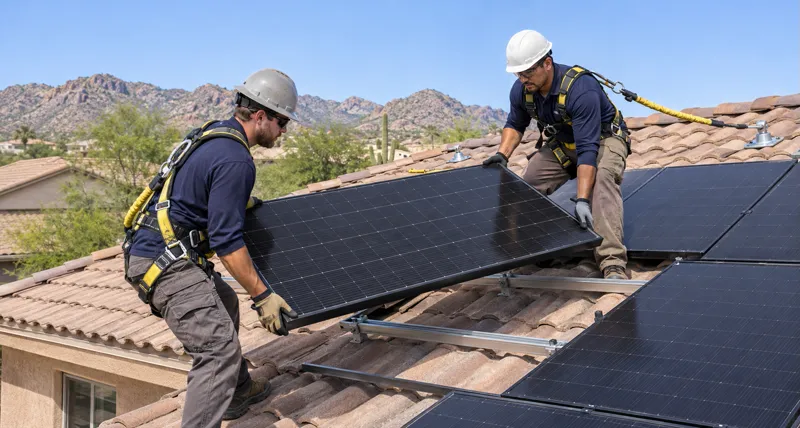
- InstallationRacking, panels, inverter and wiring. One to three days for most homes.
- InspectionThe city or county inspects the finished work.
- Permission to operateYour utility swaps or reprograms the meter and approves the system. Then you switch it on.
Read more: How long installation takes 5 steps to going solar Choosing a solar company
Next chapterUpkeep and lifespan→Chapter 10
Upkeep and lifespan
Panels have no moving parts and last 25 years or more. Keep an eye on your monitoring app, clean off the dust now and then, and expect to replace a string inverter once along the way.
| Part | Typical life | What to watch |
|---|---|---|
| Panels | 25 to 30+ years; output drops about 0.5% a year | Dust, bird droppings, cracked glass |
| String inverter | About 10 to 15 years | Error lights, a sudden drop in production |
| Microinverters | Often 25 years | A single panel showing zero in the app |
| Battery | About 10 years, warranted by cycles or years | Capacity slowly declining |
| Wiring and racking | Life of the system | Pigeons and rodents nesting under panels and chewing wires |
Do not climb onto the roof or spray panels with a pressure washer. Hard water leaves spots, and pressure can damage seals. If production drops and you cannot see why, call us; we service systems we did not install too.
Read more: Solar repair and service Cleaning and maintenance How long panels last
NextGlossary→Reference
Glossary
The words you will hear from installers and utilities. Type to filter.
- AC (alternating current)
- The type of electricity your home and the grid use. Inverters turn solar DC into AC.
- Array
- All the panels in a system, wired together.
- Battery capacity
- How much energy a battery holds, in kilowatt-hours. Usable capacity is what you can actually draw on.
- DC (direct current)
- The electricity solar panels and batteries produce. It flows one way.
- Degradation
- The slow loss of panel output with age, typically about half a percent a year.
- Demand charge
- A charge based on your highest power use in a short window, used on some utility plans including some SRP solar plans.
- Export rate
- What your utility credits you for each kWh you send to the grid. In Arizona it is usually lower than the retail price.
- Grid-tied
- A system connected to the utility grid. Most home systems are grid-tied.
- Ground mount
- Panels on a frame on the ground instead of the roof.
- Hybrid inverter
- An inverter that manages both solar panels and a battery.
- Interconnection
- The utility's process for approving your system to connect to the grid.
- Inverter
- The device that converts DC from panels or a battery into AC for your home.
- Islanding
- Running a home on its own solar and battery while cut off from the grid during an outage.
- Kilowatt (kW)
- A measure of power at one moment. System sizes are given in kW.
- Kilowatt-hour (kWh)
- A measure of energy over time: 1 kW for one hour. Your bill charges per kWh.
- Lease
- An arrangement where a company owns the panels on your roof and you pay a monthly fee.
- Microinverter
- A small inverter fitted under each panel, so each panel works independently.
- Monocrystalline
- Panels made from single-crystal silicon. Black, efficient and the most common choice today.
- Net billing
- A system where power you use is offset at retail price and exported power is credited at a separate, usually lower, export rate. Used by APS and TEP.
- Net metering
- An older arrangement where exported power was credited at the full retail rate. No longer offered to new customers by Arizona's main utilities.
- Off-grid
- A system with no utility connection, relying on panels and batteries (and often a generator).
- Power optimizer
- A device under each panel that tunes its output before sending power to a string inverter.
- Payback period
- How many years it takes for savings on your bills to equal what you paid for the system.
- Permission to operate (PTO)
- The utility's final approval to switch your system on.
- PPA (power purchase agreement)
- Like a lease, but you pay per kWh the panels produce rather than a flat fee.
- PV (photovoltaic)
- The technology in solar panels that turns light directly into electricity.
- Racking
- The rails and mounts that hold panels to the roof or ground.
- Rapid shutdown
- A safety feature, required by code, that quickly de-energizes rooftop wiring for firefighters.
- String
- A group of panels wired in a row to a string inverter.
- Temperature coefficient
- How much output a panel loses per degree of heat. Lower is better in Arizona.
- Time-of-use (TOU)
- A rate plan where power costs more at peak times, usually late afternoon and evening.
- Watt (W)
- A basic unit of power. Panels are rated in watts; 1,000 watts is a kilowatt.
No terms match. Try the search at the top of the page, or see our full solar definitions.
Reference
Common questions
Do solar panels work on cloudy days?
Yes, at reduced output. Panels still make some power under cloud, just less than in full sun. Arizona has so few fully overcast days that it makes little difference over a year.
Will my panels work during a power outage?
Only with a battery or a system designed for backup. A standard grid-tied system shuts down when the grid does, so it cannot send power onto lines that utility crews are repairing.
Can I go 100% solar and have no electric bill?
You can cover most or all of your yearly energy use, but most Arizona utilities still charge a monthly service fee, and some plans include demand charges. A well-sized system usually brings the bill down to those fixed charges or close to them.
Do solar panels damage my roof?
Not when installed properly. Mounts are fastened into the rafters and flashed and sealed against water. On tile roofs, tiles are lifted and replaced or swapped for flashed mounts. Panels also shade the roof, which can reduce wear.
Does solar increase my home's value?
Owned systems generally add to a home's appeal and value, because buyers get lower bills. Leased systems are different: the buyer has to agree to take over the lease.
Can I add more panels later?
Often, yes, though it is simpler and usually cheaper to size for future needs from the start. Microinverter systems are the easiest to expand.
Do I need to tell my HOA?
Usually yes, most HOAs ask you to submit plans. Under Arizona law they cannot ban solar, but they can make reasonable rules about placement and appearance.
Is the federal tax credit still available?
Not for new installations. The 30% residential credit covered installations completed from 2022 through December 31, 2025. If you installed before then, you may still be able to claim it or use a carryforward.